Paint correction is the process of permanently removing surface defects from a vehicle’s clear coat using controlled machine polishing.
If you’ve ever stood back from your freshly washed car and thought, “Why does it still look tired?”, you’re not alone. Many drivers eventually end up Googling what is car paint correction after noticing swirl marks, haze, or fine scratches that won’t disappear, no matter how often they wash or wax.
This guide does more than just defining the term “Car pain correction” . It is here to help you decide whether you actually need this service, what it should cost, what’s realistic to expect, and when to walk away.
What Is Car Paint Correction?
Paint correction is a controlled polishing process that removes a thin layer of clear coat to permanently reduce or eliminate visible defects in your vehicle’s finish. Think of it as “paint restoration” rather than cleaning, instead of covering problems with wax or glaze, we level the clear coat around them so the surface reflects light evenly again.
On a typical modern car, the paint system is three layers: primer, color coat, and clear coat. Most of the work happens in that clear coat, which might only be about as thick as a sticky note. Good detailers treat every polishing step like surgery measured, deliberate, and always with an eye on preserving as much clear coat as possible.
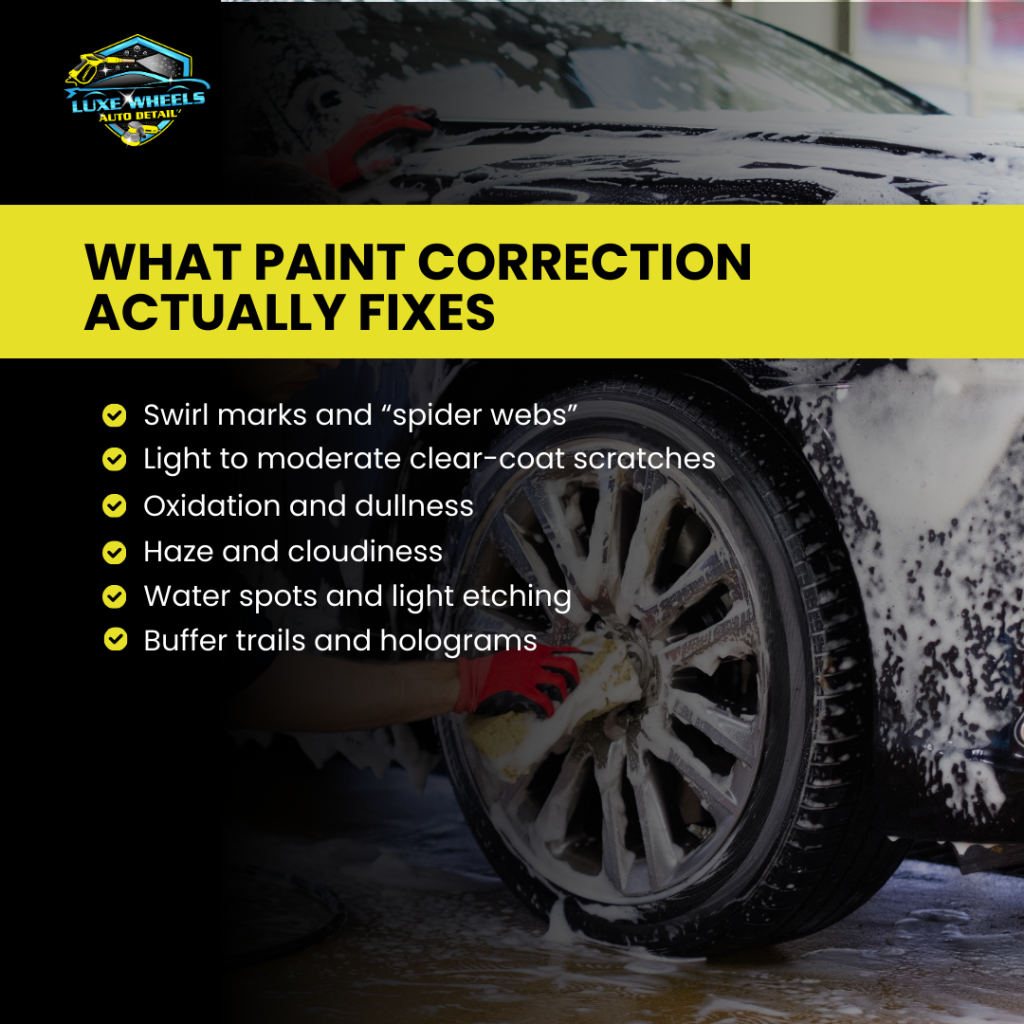
What paint correction actually fixes
A proper correction session can dramatically reduce or remove:
- Swirl marks and “spider webs” from automatic car washes or poor washing techniques
- Light to moderate clear-coat scratches (where your fingernail doesn’t catch deeply)
- Oxidation and dullness, especially on neglected or sun-beaten panels
- Haze and cloudiness from previous poor polishing or harsh chemicals
- Water spots and light etching from hard water or bird droppings
- Buffer trails and holograms left by rushed or unskilled machine polishing
The goal isn’t to chase every single scratch to perfection at all costs. It’s to restore gloss, clarity, & depth all while keeping a safe amount of clear coat on the car.
What car paint correction does not fix (deep gouges, paint failure)
So now we know what wonders car paint correction service can do, lets talk about what it can not do.
There are very clear limits to what this process can do:
- Deep scratches you can feel with your fingernail often reach beyond the clear coat. At best, correction can soften their appearance, not erase them.
- Stone chips that expose primer or metal need touch-up or repaint, not polishing.
- Clear coat failure (peeling, flaking, or heavy cracking) cannot be polished back to life; polishing only makes it worse.
- Body damage like dents, creases, or poorly repaired panels is a paint shop issue, not a detailing one.
A reputable studio like Luxe wheels auto detail will tell you where correction stops and where repainting becomes the smarter, safer option.
Why Car Paint Correction Matters More Than You Think
Impact on resale value
Buyers might not know the term “paint correction,” but they absolutely notice the difference between tired paint and crisp, glossy panels. A car that looks newer than its model year:
- Photographs better in listings
- Feels better maintained overall
- Justifies a higher asking price and reduces “lowball” leverage
For higher-value vehicles, a proper correction and refinement can pay for itself at sale time by positioning the car at the top end of its market bracket instead of in the “average condition” basket.
Visual difference before vs after correction
Most owners underestimate how much defects are robbing their paint of depth. Under direct sunlight or a workshop inspection light, swirl marks scatter light in different directions, so the paint looks flat, greyed-out, and “chalky”.
After a careful correction:
- Colors look richer and deeper
- Metallic flake pops and “sparkles” as it should
- Reflections become sharper and more mirror-like
This is why many people feel like they “fell in love with the car again” after a proper detail. You’re not imagining it the surface is physically smoother and more optically correct.
Why washing and waxing can’t fix paint defects
Washing removes loose contamination, and waxing adds temporary gloss and protection. Neither changes the underlying shape of the clear coat.
- Swirls and scratches are physical grooves.
- Wax and sealants may fill them slightly, but as they wear off, the defects reappear.
- Even premium products can only mask defects, not remove them.
To permanently improve the finish, you need controlled abrasion using compounds and polishes with a machine so the peaks of the clear coat are reduced to the level of the valleys around the defect.
Types of Paint Defects Paint Correction Removes
Swirl marks and spider webbing
These look like circular cobwebs when you shine a light onto the paint. They’re usually caused by:
- Automatic car washes with harsh brushes
- Dirty wash mitts and towels
- Wiping dust off a dry car
Swirls are shallow, widespread, and ideal candidates for machine polishing. Correction levels the clear coat so those circular scratches disappear or become invisible in normal lighting.
Light vs moderate scratches
Not all scratches are equal:
- Light scratches: Only in the top of the clear coat; often vanish completely with a good polishing cycle.
- Moderate scratches: Deeper into the clear; can often be significantly reduced, but might still be faintly visible under direct inspection.
Detailers judge them with the fingernail test (if your nail catches deeply, it’s usually beyond safe correction) and by measuring paint thickness to avoid over-thinning the clear coat.
Oxidation and dull clear coat
Oxidation is especially common in hot, high-UV climates. In regions like Atlanta, prolonged sun exposure accelerates clear coat breakdown, which we explain in detail in our guide on car paint oxidation and sun damage in Atlanta.
Correction removes the oxidized layer and reveals healthy clear underneath. On older, softer paints, this can be dramatic, making a decade-old car look several years younger after one session.
Water spots and etching
Minerals from hard water, sprinklers, or rain can leave:
- Surface deposits that sit on top of the clear coat
- Etching, where minerals and acids slightly bite into the clear
Light spotting often responds well to mild polish. Etching may need a more aggressive combination of pad and compound to level the damage. Severe etching (left for months or years) may still leave faint outlines, even after careful work.
Buffer trails and holograms
These are machine-induced defects created by improper use of rotary polishers or poor pad/product choice. Under strong light, the paint looks like it has streaks or “ghosting” patterns.
A skilled detailer uses dual-action machines, proper pads, and finishing polishes to remove these marks and refine the surface to a crisp, uniform gloss.
Car Paint Correction Process (Step-by-Step)
Paint inspection and thickness measurement
Everything starts with assessment. We at Luxe wheels start with :
- Inspecting the car under multiple lighting conditions
- Identify repainted panels, previous correction, or problem areas
- Use a paint thickness gauge to measure how much material is available to safely work with
This step prevents over-polishing, especially on edges or previously corrected panels where the clear coat may already be thin.
Decontamination (wash + clay bar)
Before any machine touches the paint, contaminants have to go:
- Thorough wash using safe methods (two-bucket wash, pH-balanced shampoo, separate wheel tools).
- Chemical decontamination to remove tar, iron particles, and fallout.
- Mechanical decontamination using a clay bar or synthetic clay media to remove bonded contaminants.
Tip : Skipping this stage risks dragging embedded grit across the surface with a machine, creating new scratches while trying to fix old ones.
Test spot and pad/compound selection
Instead of guessing, we preform a test section on a representative panel. We experiment with:
- Different compounds or polishes
- Foam, microfiber, or wool pads
- Machine speed and pressure
The idea is to find the least aggressive method that achieves the desired result, then repeat that system around the car.
Single-stage paint correction
Single-stage work uses one polishing step (often a medium-cut polish) aimed at:
- Removing light to moderate defects
- Dramatically boosting gloss
- Leaving a finish that’s 60–80% improved without chasing perfection
This is ideal for daily drivers where the owner wants a big visual upgrade but doesn’t need concours-level perfection.
Multi-stage paint correction
Multi-stage correction is more intensive:
- Cutting stage – A heavier compound and more aggressive pad remove deeper defects.
- Refining stage – A finer polish and pad combination remove haze from the cutting step.
- Optional jeweling stage – Ultra-fine finishing for show-level clarity (often reserved for special cars).
This approach is more time consuming and removes more clear coat, so it’s best reserved for vehicles where maximum visual impact and show-quality finish are justified.
Final polish and inspection
Once the main work is complete:
- The car is wiped down with a panel wipe to remove polishing oils that can temporarily hide defects.
- The paint is inspected under different lights and angles.
- Only then is protection applied (wax, sealant, ceramic coating, or film).
The inspection stage is where you see the true, honest result not something disguised by gloss-enhancing products.
Single-Stage vs Multi-Stage Paint Correction
Differences in results
Here’s how they typically compare:
| Aspect | Single-Stage | Multi-Stage |
| Defect removal | Light–moderate | Moderate–severe (within safe limits) |
| Finish quality | Big improvement, not “perfect” | Much closer to flawless |
| Gloss & clarity | High | Very high / show-car |
| Clear coat removal | Lower | Higher (managed carefully) |
Single-stage will often make a daily car look “wow, that’s clean”, while multi-stage pushes the car into “showroom or show car” territory.
Time, cost, and risk comparison
- Time
- Single-stage: Often 4–8 hours, depending on size and condition
- Multi-stage: Can easily extend to 1–3 full days
- Cost
- Single-stage is more budget-friendly and accessible
- Multi-stage is a premium service reflecting the time, expertise, and risk involved
- Risk
- Every polishing pass removes clear coat. Multi-stage work removes more, so it requires better measurement, technique, and judgement.
- Every polishing pass removes clear coat. Multi-stage work removes more, so it requires better measurement, technique, and judgement.
Which option is right for your car?
Single-stage usually makes sense if:
- It’s a daily driver or family car
- You want it to look noticeably better without chasing microscopic defects
- Your budget is limited but you still value good presentation
Multi-stage is more appropriate when:
- You own an enthusiast, luxury, or collectible car
- The vehicle has heavy defects but healthy clear coat
- You’re preparing for sale, a show, or long-term ceramic coating on a high-value car
Tip : If you’re unsure, ask the studio to show you test spot results for both levels on your own car, then decide based on the visual difference and the quote.
How Much Does Car Paint Correction Cost?
Paint correction pricing varies based on paint condition, vehicle size, and how many polishing stages are required. While rates differ by country and shop reputation, professional detailing studios tend to fall within well-defined price bands when you look at real-world market data.
The most important thing to understand is what you’re paying for: total labor hours, the level of defect removal achieved, and whether any paint protection is included after correction.
Average Car Paint Correction Cost Ranges
Across professional detailing markets, typical pricing looks like this:
- Single-stage paint correction: $300 – $800
Focused on improving gloss and removing light swirl marks and haze. - Two-stage paint correction: $600 – $1,500
Includes a cutting stage to remove deeper defects, followed by a refining polish for clarity. - High-end multi-stage correction: $900 – $2,500+
Designed for heavily damaged paint, high-value vehicles, or show-level finishes where maximum correction is required.
Higher prices generally reflect more machine time, advanced compounds and pads, stricter inspection standards, and a greater emphasis on clear-coat safety.
Cost by Vehicle Size (Sedan, SUV, Truck)
Vehicle size directly affects pricing because it determines total surface area, panel height, and time spent repositioning equipment.
Typical price ranges by size:
- Small hatchback / compact sedan: $300 – $700
Less surface area and easier access reduce labor time. - Mid-size sedan / coupe / small crossover: $500 – $900
Balanced workload with moderate panel size and height. - SUVs, trucks, vans: $700 – $1,200+
Larger panels, higher rooflines, and increased polishing time push costs higher.
If two shops quote very different prices, check the vehicle type. A compact coupe and a three-row SUV are not comparable jobs, even at the same correction level.
Cost by Correction Level (1-Stage, 2-Stage, 3-Stage)
Most professional studios price paint correction by stages, not by products used.
- 1-Stage Correction: $300 – $800
A single polishing step that significantly improves gloss and removes light defects. - 2-Stage Correction: $600 – $1,500
Combines a cutting step for defect removal with a finishing polish for clarity and depth. - 3-Stage or More: $900 – $2,500+
Used for severe defects, neglected paint, or vehicles requiring near-perfect finishes.
Each additional stage represents several more hours on the machine, not just a different service label.
Why Very Cheap Paint Correction Is Usually a Red Flag
Prices that sit far below these ranges often indicate compromises, such as:
- Minimal decontamination or prep work
- Heavy reliance on fillers instead of real defect removal
- Rushed polishing with aggressive compounds
- Poor lighting that hides uncorrected defects
Because clear coat is a limited resource, low-quality correction can permanently reduce how much safe polishing the paint can tolerate in the future
What These Prices Usually Include
At reputable shops, paint correction pricing typically covers:
- Full wash and chemical decontamination
- Mechanical decontamination (clay bar or equivalent)
- Machine polishing at the agreed correction level
- Proper inspection lighting and final wipe-down
- Basic paint protection (wax or sealant)
Premium ceramic coatings or paint protection film are usually priced separately
Factors That Affect Paint Correction Pricing
Paint condition and defect severity
Heavily swirled, scratched, or oxidized paint simply takes longer to restore. More time on the machine means higher labor cost. On the other hand, newer cars with light wash marring might only need an enhancement pass.
Vehicle size and paint hardness
Two key variables:
- Size – More paint to correct, more time required
- Hardness – Some clear coats (often German brands) are harder and require more aggressive combinations and more passes; others (often Japanese brands) are softer but easier to mark, requiring extra care during finishing
Detailers factor both into their quotes because they directly affect effort.
Experience of the detailer
You’re paying not just for time, but for judgement and skill:
- Knowing when to stop to protect the clear coat
- Choosing safe combinations that work efficiently
- Understanding different paint systems and how they behave
Experienced specialists often charge more but are also far less likely to cause damage.
Tools, compounds, and time involved
High-quality machines, pads, and polishes cost money, and consumables wear out. Thorough work also includes:
- Multiple machine types (e.g., different orbit sizes for tight areas)
- Frequent pad cleaning or replacement
- Proper masking of trim and sensitive areas
All of this is built into the quote for serious car paint correction services.
Location and market pricing differences
A shop’s overheads rent, utilities, insurance, staff vary wildly by location. Urban centers and affluent areas typically have higher pricing than smaller towns. What matters most is value for money, not just chasing the lowest number.
Paint Correction vs Other Paint Services
Paint correction vs polishing
“Polishing” is often used loosely. In a professional context:
- General polishing might be a quick gloss-enhancing step after a wash, with modest defect removal expectations.
- Correction is a structured, measured process focused on permanent defect removal with clear expectations, documentation, and often before/after readings.
Not all polishing is correction, but all correction involves polishing.
Paint correction is also just one part of the broader professional detailing process. If you’re unfamiliar with how different services fit together, our complete guide to what car detailing is explains how paint correction compares to other exterior and interior detailing services.
Paint correction vs waxing
Waxing:
- Adds a temporary protective layer
- Boosts gloss and slickness
- Does not significantly remove defects
Correction:
- Reshapes the surface of the clear coat
- Permanently reduces visible defects within safe limits
- Is typically followed by waxing, sealing, or coating for protection
You can think of wax as makeup, while correction is more like skincare one hides, the other treats.
Paint correction vs ceramic coating
Ceramic coatings:
- Provide long-term protection and easier maintenance
- Enhance gloss, but mainly by coating whatever surface they’re applied to
If you coat scratched, swirled paint, the defects get preserved under a durable layer. This is why many reputable studios strongly recommend some level of correction before applying a coating, especially on high-value vehicles.
Paint correction vs repainting
Repainting is the nuclear option expensive, time-consuming, and not always necessary. Repaint when:
- The clear coat is failing
- There’s structural damage or significant previous poor repairs
- The defects run deep into base coat or metal
Correction is ideal when the paint is structurally sound but visually tired. It’s less invasive and keeps the car closer to its original factory finish.
Do You Need Paint Correction Before Ceramic Coating?
What happens if you skip paint correction
If you apply a coating to uncorrected paint:
- Swirls, scratches, and water spots remain visible sometimes more so under enhanced gloss.
- The coating’s durability is unaffected, but the overall look might disappoint you.
- Removing or redoing the coating later to fix the underlying defects is more work and cost than doing it right once.
For brand-new cars, you might get away with a light refinement; for used or daily-driven vehicles, some level of correction is almost always smart.
When light correction is enough
Light prep and refinement make sense if:
- The car is new or very well-maintained
- You mainly see light wash marring, not heavy swirling or deep defects
- Your priority is long-term protection and easier cleaning rather than show-level perfection
In this scenario, a single polishing step before coating offers an excellent balance of result vs cost vs clear coat safety.
How correction improves ceramic coating lifespan
A properly corrected and prepped surface:
- Allows the coating to bond more evenly
- Reduces microscopic peaks and valleys that trap dirt
- Makes it easier to wash safely, which in turn reduces future defects
So it’s not just about looks the right prep helps the protection product perform closer to its advertised potential.
How Long Does Paint Correction Last?
With proper maintenance
If you adopt safe washing habits after the work is done:
- Use pH-balanced shampoo and quality wash mitts
- Avoid automatic brush washes
- Dry with soft microfiber towels or blower
Then the improved finish can stay in excellent shape for years, especially if it’s protected with a coating or film. You may only need light periodic polishing rather than another heavy correction session.
Without protection
Unprotected paint, even after a beautiful correction, will:
- Accumulate new marring more quickly
- Lose gloss faster due to environmental contamination
- Require more aggressive future work to restore
You’re essentially burning through your “clear coat budget” faster, which isn’t ideal long-term.
Role of ceramic coating and PPF
- Ceramic coatings help resist wash marring, chemical stains, and UV damage, and make maintenance easier. They don’t make the paint invincible, but they significantly slow down deterioration.
- Paint protection film (PPF) adds a physical barrier against stone chips, impact, and some scratching ideal for high-impact areas like front bumpers and hoods.
Combining good correction with targeted PPF and a quality coating on the remaining panels is often the sweet spot for long-term cosmetic health.
Can You Paint Correct a Car Yourself?
Tools required for DIY paint correction
If you intend to learn how to paint correct a car at home, you’ll need more than a bottle of compound and hope:
- Dual-action (DA) polisher (safer for beginners than rotary machines)
- Assortment of foam or microfiber pads (cutting, polishing, finishing)
- Quality compounds and finishing polishes
- Paint-safe tape for masking trim and edges
- Good lighting and plenty of clean microfiber towels
- Ideally, a garage or shaded workspace
You’ll also need patience and a willingness to practice on less critical areas first.
Common beginner mistakes
Professionals often see the fallout from DIY attempts:
- Working on dirty or poorly decontaminated paint, grinding contaminants into the surface
- Using too much pressure or spending too long in one spot
- Starting with overly aggressive pads or compounds “just to speed it up”
- Not wiping and inspecting properly between passes
- Using cheap towels that reintroduce marring
Most of these mistakes come from rushing and not respecting how thin the clear coat really is.
Risk of burning clear coat
Burning through clear coat means you’ve polished so aggressively that you’ve removed the protective layer and exposed the base coat beneath often visible as a dull or discolored patch. Repairing this typically requires repainting that panel.
Modern DA polishers make burning far less likely, but it’s still possible on:
- Edges and body lines
- Previously polished or repainted panels
- Very thin OEM finishes
This is why pros constantly move, measure, and check their work rather than blindly grinding away.
When DIY makes sense (and when it doesn’t)
DIY can make sense if:
- You’re willing to invest in tools and learning
- You’re working on an older or lower-value car where perfection isn’t critical
- You enjoy the process and take a cautious approach
It’s better to hire a professional when:
- The car is expensive, collectible, or sentimental
- The paint is in rough condition
- You plan on long-term protection with coatings or PPF and want a perfect baseline
In short: if a mistake would really hurt to look at every day, it’s worth getting expert help.
Professional Paint Correction Services – What to Expect
Time required (hours vs days)
A serious job is not an in-and-out wash bay service. Rough guide:
- Basic enhancement (single-stage): often half a day to a full day
- Full multi-stage work: one to three days, depending on vehicle and expectations
If a shop is promising an “extreme transformation” in under two hours, be skeptical.
Before/after inspection process
Good studios will:
- Walk the car with you beforehand, pointing out defects and setting realistic expectations
- Conduct a test spot and show you the difference
- Invite you to inspect the result under different lighting once the work is done
This collaborative process ensures you understand what you’re paying for and what has been safely achieved.
What a quality service includes
Beyond just polishing, a thorough correction job usually includes:
- Proper wash and decontamination
- Careful masking of sensitive trims, badges, and edges
- Measured, staged machine work with appropriate products
- Panel wipe and protection (wax, sealant, or coating)
- Basic cleanup of glass, trims, and jambs so the whole car looks cohesive
The difference between a rushed job and a careful one is obvious the moment you see the car in direct sunlight.
Red flags to avoid when choosing a provider
Be cautious if:
- The price is dramatically lower than reputable local studios for the same promises
- The provider can’t clearly explain their process or show example work
- They rely heavily on glazes or fillers to “hide” defects instead of correcting them
- They won’t discuss clear coat safety or limitations at all
A trustworthy professional is happy to talk about what they won’t do in order to protect your paint.
Who Should Get Car Paint Correction?
New car owners
New cars aren’t always perfect:
- Transport, storage, and dealership prep can introduce swirls and light marring.
- A light refinement can remove these issues and lay a flawless base for protection.
If you’re planning to keep the car for years, starting from a clean, corrected baseline is a smart long-term move.
Used car buyers
If you’ve just bought a used vehicle, correction can:
- Erase years of poor washing habits from the previous owner
- Reveal any hidden bodywork or repainted panels more clearly
- Make you feel like you’re driving something far fresher than the paperwork suggests
It’s one of the highest-ROI steps you can take after purchase.
Lease returns
Before handing a car back at the end of a lease, a gentle refresh can:
- Improve visual condition
- Reduce the risk of “excess wear and tear” charges related to cosmetic issues
You don’t need show-car perfection here just a clean, well-presented vehicle that looks cared for.
Enthusiasts and show cars
If you’re the type who notices every mark under a petrol station light, you already know the value of high-end paint refinement for cars:
- Show events, photo shoots, or club meets
- Long-term collection preservation
- Enjoyment every time you walk up to the car
For this group, premium correction is as much about personal satisfaction as it is about value.
Who Should NOT Get Paint Correction?
Extremely thin or failing clear coat
If measurements or visual inspection show that the clear coat is already compromised:
- Further polishing may do more harm than good
- It’s often safer to stabilize the surface and plan for repaint, rather than chase gloss
A conscientious detailer will decline correction work in these cases.
Vehicles planned for repaint
If a car is already booked for a full respray, investing heavily in correction beforehand rarely makes sense. Basic cleaning and temporary protection might be all that’s needed until the paint shop takes over.
Cars with unrealistic expectations
If someone expects:
- Every defect removed on a heavily abused daily driver
- Zero risk and minimal clear coat removal
- A “like new” result on failing paint
then correction is the wrong solution. The best outcomes happen when expectations, budget, and paint reality align.
Real-World Paint Correction Mistakes
Over-correcting and removing too much clear coat
One of the biggest professional concerns is chasing perfection at the expense of long-term paint health. Every cut stage eats into the clear. If each owner demands maximum correction, the car simply won’t tolerate many more future polishing sessions.
Experienced detailers know when to stop and leave a few deeper marks safely softened but not erased.
Using aggressive compounds unnecessarily
Heavy compounds and aggressive pads have their place, but:
- On softer paints, they can introduce haze and micro-marring that’s hard to fully remove.
- On already-thin clear coat, they risk irreversible damage.
The best technicians start as mild as possible and only escalate when necessary, not “because that’s what’s on the shelf.”
Skipping paint thickness checks
Working blind is dangerous. Without a gauge, you don’t know:
- Whether a panel was previously sanded or corrected
- If a repainted panel has unusual thickness variance
- Where edges or body lines might be already vulnerable
Skipping this step is one of the most common shortcuts in low-end operations.
Poor lighting hiding defects
Under soft workshop lighting, a car can look flawless. Under sun or a strong inspection lamp, holograms and missed defects jump out.
Pros use:
- LED inspection lights
- Multiple angles and color temperatures
- Sunlight checks when possible
If the car was only ever inspected under dim, flattering light, you haven’t really seen the true result.
Expert Tips to Maintain Paint After Correction
Proper washing techniques
To keep the refined finish looking good:
- Use two-bucket washing (wash and rinse) with grit guards if possible.
- Choose quality wash mitts and microfiber towels.
- Pre-rinse thoroughly to remove loose dirt before touching the paint.
Most wash-induced defects come from dragging dirt across the surface avoid that, and your finish will last far longer.
Safe drying methods
Drying is where many people reintroduce scratches:
- Use soft, clean drying towels and blot or glide gently, don’t scrub.
- For heavily protected cars, a dedicated car dryer or blower can remove most water without touching the paint.
Never use household bath towels or chamois-style products that can grab and drag.
Maintenance frequency
A good rhythm:
- Wash regularly (weekly or biweekly depending on use and environment)
- Top up protection with spray sealants if recommended by your detailer
- Book a light annual maintenance polish if needed, instead of letting defects build up until heavy correction is required again
The goal is to need less aggressive work over the life of the vehicle.
Recommended protection options
After correction, consider:
- Ceramic coating for long-lasting protection and easier cleaning
- PPF on high-impact areas (bumper, hood, mirrors) if you drive a lot of highway miles
- Quality wax or sealant if you prefer traditional products and are happy to reapply more often
The best choice depends on how long you plan to keep the car, how you use it, and how much you enjoy maintaining it.
Paint Correction Myths (Debunked)
“It fixes all scratches”
No, it doesn’t and it shouldn’t try to. Some defects are too deep to safely chase. Responsible technicians aim for maximum improvement with minimum risk, not an unrealistic 100% defect removal on every panel.
“It’s the same as waxing”
Waxing hides; correction heals (within limits). Wax can make a scratched car look nicer for a short time, but when it wears off, the truth reappears. Correction alters the surface itself, so the improvement is baked into the paint, not just sitting on top.
“Once corrected, paint stays perfect forever”
Your car lives in the real world rain, dust, brushes, kids, parking lots. Even the best correction won’t stay perfect if:
- It’s run through harsh automatic washes
- It’s rarely washed, or always washed badly
- It’s never protected afterward
Think of correction as a reset button, not a permanent shield.
FAQs – Car Paint Correction
What is car paint correction?
It’s a careful machine polishing process that removes a small amount of clear coat to permanently reduce swirls, light scratches, oxidation, and other defects, restoring gloss and clarity while preserving paint health.
How long does paint correction take?
Anywhere from a half-day for a light single-stage enhancement to several days for multi-stage work on larger or heavily damaged vehicles. The more defects you want removed, the more time it takes.
Is paint correction worth the cost?
It usually is if:
- You care about how your car looks
- You’re planning to keep it for several years
- You’re preparing a sale or protecting it with a coating
The visual transformation and impact on perceived value are often far greater than, say, replacing a set of cosmetic accessories.
How often should paint correction be done?
Ideally, not very often. With good maintenance and protection, you might only need one substantial correction in the time you own the car, followed by light refinement as needed.
Can paint correction damage my car?
When done correctly using proper tools, measurements, and technique it’s safe. Damage generally happens when:
- Untrained operators use aggressive methods carelessly
- Paint is already thin or failing and correction is attempted anyway
- Work is rushed without proper inspection
This is why choosing a reputable, transparent provider matters.
Is paint correction necessary for new cars?
Not always, but surprisingly often. Many new vehicles arrive with transport-induced marring or dealer-installed swirls. A light refinement can bring the finish up to the standard you probably assumed it had from the factory and prepare it properly for long-term protection.